Buy asapakademia.pl ?
We are moving the project
asapakademia.pl .
Are you interested in purchasing the domain
asapakademia.pl ?
domain@kv-gmbh.de · 0541-91531010
Buy asapakademia.pl ?
What will workshops for disabled people look like in 20 years?
In 20 years, workshops for disabled people will likely be more inclusive and accessible, with a focus on utilizing technology to cater to individual needs. These workshops may offer virtual reality training, online resources, and remote participation options to accommodate a wider range of disabilities. There will also be a greater emphasis on promoting independence, self-advocacy, and skill development tailored to each person's abilities and interests. Overall, workshops for disabled people in the future will strive to create a more inclusive and empowering environment for individuals with disabilities to thrive and reach their full potential. **
Why was education underfunded for years?
Education was underfunded for years due to a variety of reasons. One major reason is competing budget priorities, such as healthcare, infrastructure, and defense, which often took precedence over education funding. Additionally, economic downturns and budget constraints led to cuts in education spending. Furthermore, political disagreements and lack of consensus on the importance of education investment also contributed to underfunding. These factors combined to create a situation where education was not given the necessary financial support to meet the needs of students and schools. **
Similar search terms for Years
Top-Angebote
Products related to Years:
-
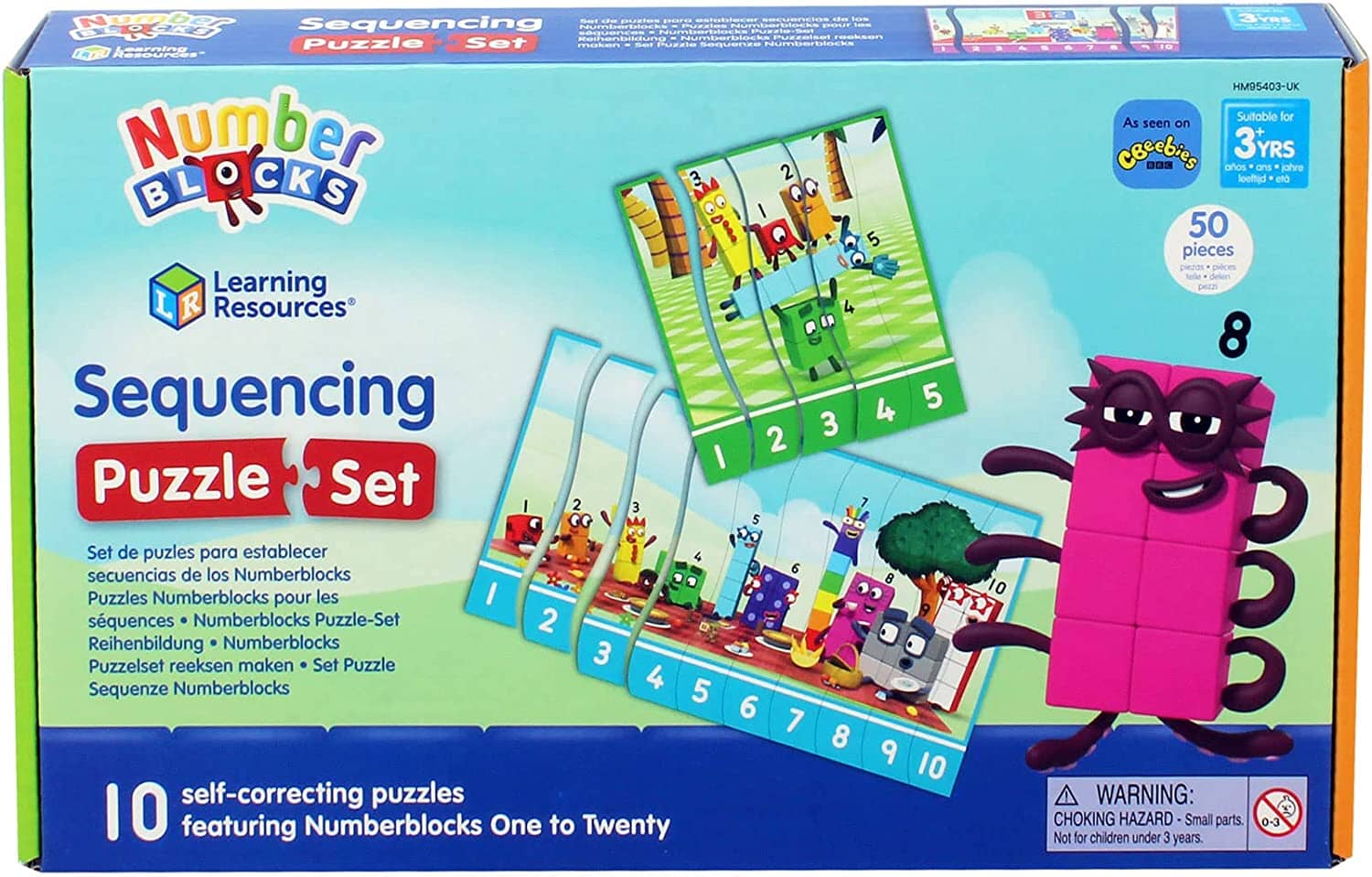
Numberblocks Sequencing Puzzle by Learning Resources - Ages 3 Years+ - Educational Toy Learning ResourcesNUMBERBLOCKS AS SEEN ON TV: Help children learn to sequence the numbers 1–20 in the correct order with their friends Numberblocks One to Twenty from the hit TV series. LEARN TO COUNT 1–20: Make learning to count 1–20 in the correct order fun for young children! As children complete the 20 colourful puzzles, they’ll be building basic maths skills along with colour recognition and fine motor skills. MATCH NUMBERS & PICTURES: Start with the 1-5 Numberblocks sequencing puzzles – can you put your friends One, Two, Three, Four, and Five in the correct order? As children learn and grow, progress to the next puzzle. PERFECT FOR LEARNING: Each of these Numberblocks maths puzzles is colour-coded for easy set-up. Each puzzle also has a number line, a teaching tool to help children sequence numbers and use to solve simple maths problems. INCLUDES: 10 double-sided puzzles - 4 each of puzzles for 1–5 (13cm L x 15cm W) and 1–10 (26cm L x 15cm W) and 2 for numbers 1–20 (51cm L x 15cm W).11,99 £*Shipping: 2,99 £Secure redirect to the provider
-
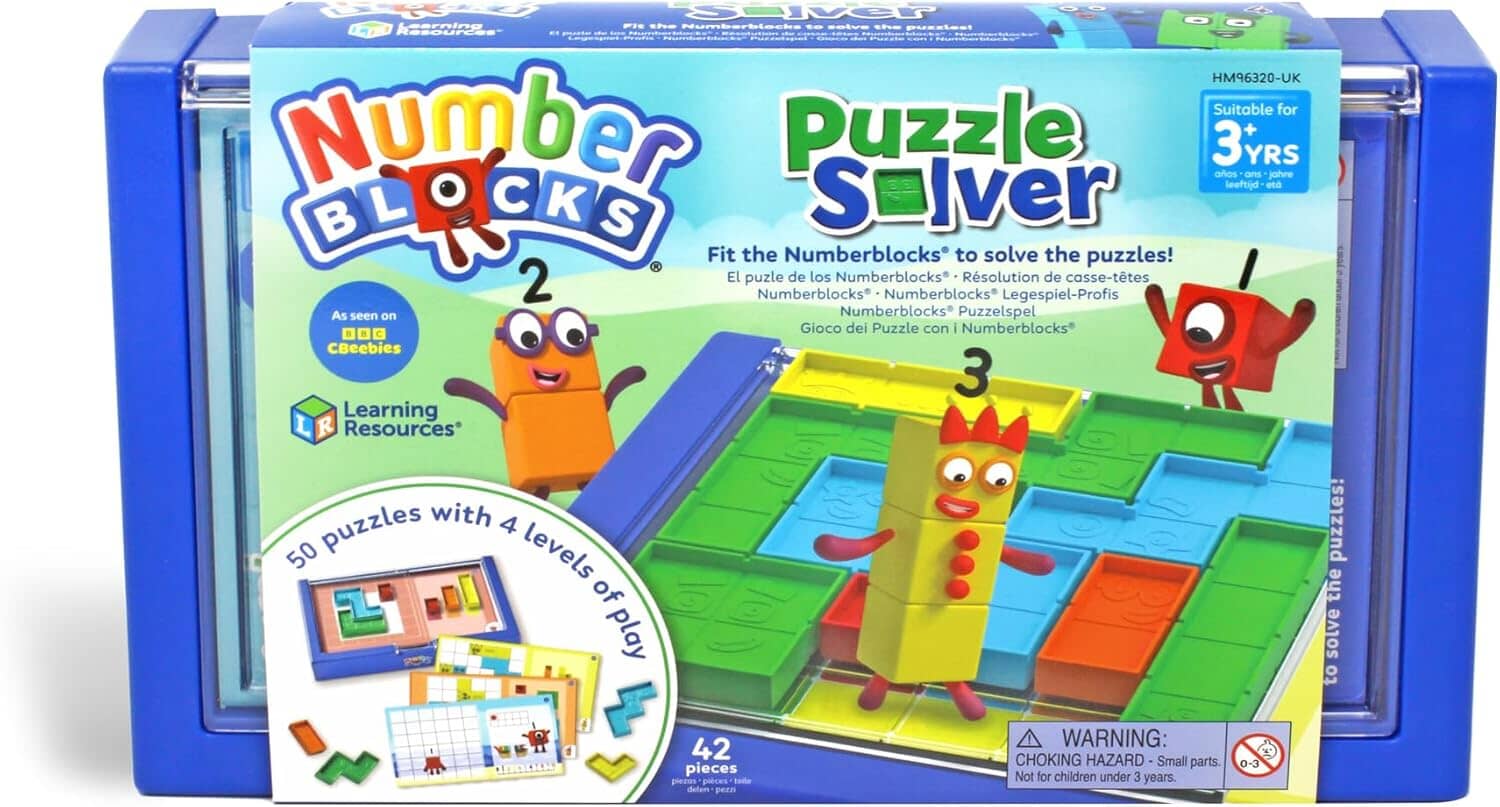
Numberblocks Puzzle Solver by Learning Resources - Ages 3 Years+ - Educational Toy Learning ResourcesPuzzle pals, it’s time to play and learn with the Numberblocks® Puzzle Solver where players place the Numberblocks pieces to solve the maths puzzles. As children twist, flip and place the pieces onto the 50 puzzle challenges, they’ll be building their maths, problem-solving, critical thinking and spatial reasoning skills through hands-on play. This solitaire game is easy to set up and play, simply choose a challenge card and insert it under the clear tray. Then find the Numberblocks puzzle pieces that match the card and use them to complete the puzzle. With 4 challenge levels, this portable puzzle game will keep your child engaged and learning as they grow. What’s more, all the pieces store inside the play case, making it an ideal travel game. Build maths skills through fun puzzle play with Numberblocks Puzzle Solver. How to play: Choose a challenge card and insert it under the clear tray. Find the Numberblocks puzzle pieces that match the card. Use the pieces to complete the puzzle. There are 50 challenges and 4 levels of play, to keep your child engaged and learning as they grow. Includes 25 double-sided challenge cards, 16 character pieces, 1 plastic play case and Activity Guide. Pieces store inside the play case after playtime is over.16,99 £*Shipping: 2,99 £Secure redirect to the provider
-
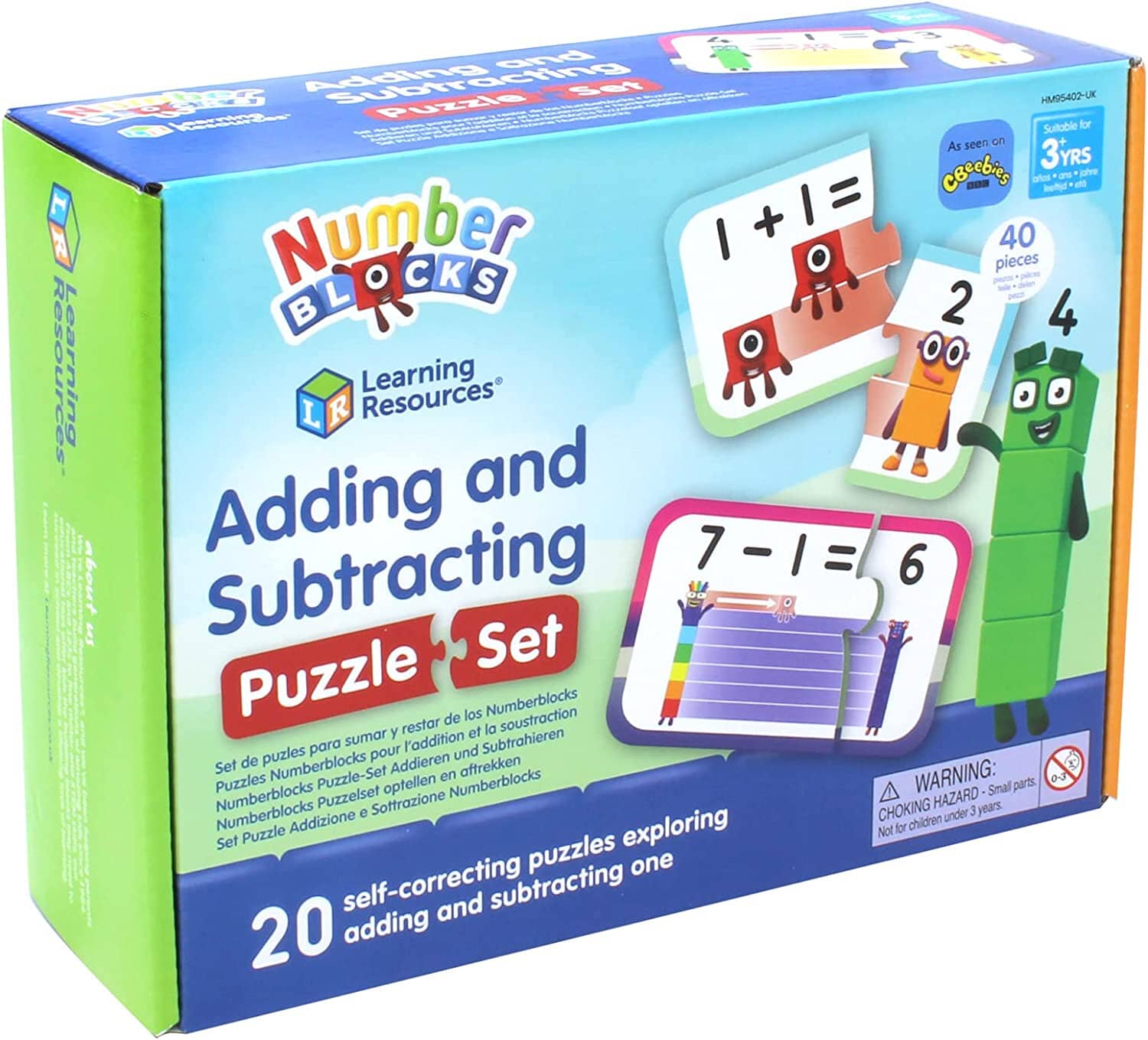
Numberblocks Adding and Subtracting Puzzle Set by Learning Resources - Ages 3 Years+ Learning ResourcesNUMBERBLOCKS AS SEEN ON TV: Discover what happens when you add or subtract 1 with these simple 2-piece Numberblocks jigsaw puzzles based on the award-winning TV series. ADD & SUBTRACT: Make learning simple addition and subtraction fun for young children! As children complete the 20 colourful puzzles, they’ll be building basic maths skills along with colour recognition and fine motor skills. MATCH NUMBERS & PICTURES: See the addition or subtraction question, count the Numberblocks on the puzzle piece, and then find the correct answer piece. SELF-CORRECTING PUZZLES: Each of these clever self-correcting Numberblocks counting puzzles fits together in a unique way, so there’s only one right answer. INCLUDES: 20 x 2-piece puzzles. The chunky pieces are made from durable card and are easy for little hands to hold. Pieces store in the reusable packaging after play. Completed puzzles measure 15cm L x 10cm W.14,99 £*Shipping: 2,99 £Secure redirect to the provider
-
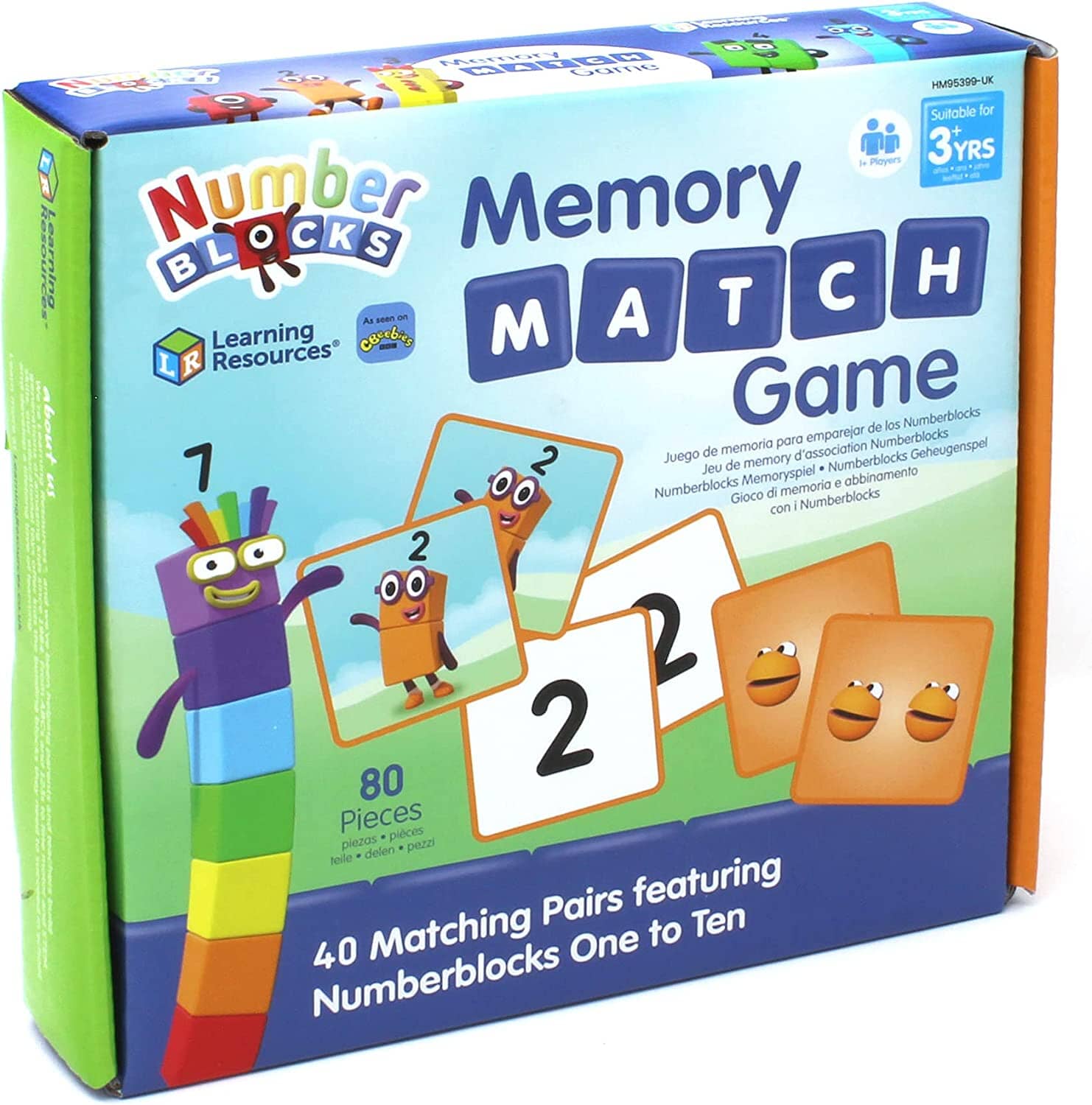
Numberblocks Memory Match Game by Learning Resources - Ages 3 Years+ - Educational Toy Learning ResourcesNUMBERBLOCKS AS SEEN ON TV: Test memory skills, build number sense, and practise early maths concepts with this fun Numberblocks matching pairs game. Children will love finding and pairing their favourite Numberblocks and friends. MEMORY GAME FOR AGES 3+: Matching pairs is a classic memory game for children. This fun picture snap pairs game for kids age 3 years and up promotes number recognition and matching skills as children play and learn. 40 MATCHING PAIRS: Flip over the cards, and then match and pair by Numberblocks One to Ten, Numberlings, Number Fun, and Numberblobs. Use fewer cards for younger children and add more cards to make the game more challenging for older children. HIGH QUALITY: The 80 full-colour cards are made from durable card and feature colour-coded borders for easy game set-up. Cards measure 5cm x 5cm and are perfectly sized for little hands to hold as children play. Suitable for 1 or more players. INCLUDES: 80 full colour cards and How to Play guide. Cards and guide are easy to pack away and store in the durable, reusable packaging. This feature makes our Numberblocks Memory Match Game an ideal travel game.11,99 £*Shipping: 2,99 £Secure redirect to the provider
-
How can one proceed at 27 years old without any training or education?
At 27 years old without any training or education, one can start by assessing their interests, strengths, and skills to determine potential career paths. They can consider enrolling in online courses, vocational training programs, or community college classes to gain relevant skills and knowledge. Networking with professionals in industries of interest, seeking mentorship, and gaining hands-on experience through internships or volunteering can also be beneficial in building a career without formal education. It's important to stay motivated, be open to learning, and be willing to put in the effort to succeed in a chosen field. **
-
Starting an education at 25 years old?
Starting an education at 25 years old is a great decision for many people. It allows individuals to pursue their academic and career goals, gain new skills, and expand their knowledge. Many people choose to start or continue their education at this age due to personal or professional reasons, and it can lead to new opportunities and personal growth. It's never too late to invest in education and work towards achieving your goals. **
-
Do repeated years count towards compulsory education?
In most cases, repeated years do count towards compulsory education. Compulsory education laws typically require students to attend school for a certain number of years or until they reach a certain age, regardless of whether they repeat a grade. However, the specific rules may vary by state or country, so it's important to check the local laws and regulations to confirm whether repeated years count towards compulsory education. **
-
Why does training last three years?
Training typically lasts three years in order to provide individuals with a comprehensive education and hands-on experience in their chosen field. This duration allows for a deep understanding of the subject matter, ample time for skill development, and the opportunity to gain practical knowledge through internships or on-the-job training. Additionally, a three-year training period ensures that individuals are well-prepared and competent in their profession before entering the workforce. **
"Excuse for physical education at 18 years old?"
At 18 years old, there may be various reasons someone could provide as an excuse for not participating in physical education. Some possible reasons could include a medical condition or injury that prevents them from engaging in physical activities, a scheduling conflict with other academic or work commitments, or personal reasons such as feeling uncomfortable in a group exercise setting. It is important for individuals to communicate their reasons to their school or instructor in order to find a suitable alternative or solution. **
Excuse for physical education at 18 years old?
At 18 years old, a valid excuse for not participating in physical education could be a medical condition or injury that prevents the individual from engaging in physical activity. In such cases, a doctor's note or medical documentation may be required to support the excuse. Additionally, personal reasons such as mental health issues or religious beliefs could also be considered valid excuses for not participating in physical education at 18 years old. It is important to communicate any valid reasons for not participating in physical education to the appropriate school authorities. **
Top-Angebote
Products related to Years:
-
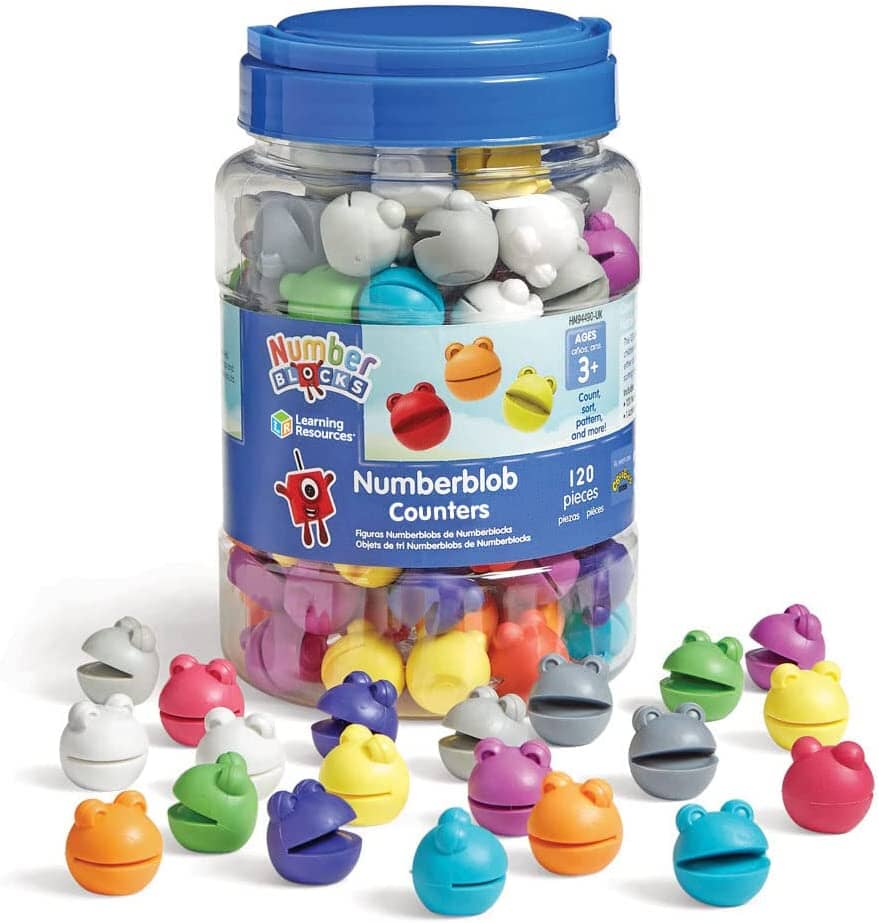
Numberblocks Numberblob Counters Set by Learning Resources - Ages 3 Years+ Learning ResourcesNUMBERBLOCKS AS SEEN ON TV: Bring the magic of on-screen maths learning with the Numberblocks TV series to life in the classroom with these Numberblocks Numberblob Counters VERSATILE TEACHING RESOURCE: Use these counters for teaching a range of essential early years maths skills including counting, sequencing, grouping, patterning, sorting, addition, subtraction, subitising, cardinality, and more MULTIPLE WAYS TO SORT: Numberblob Counters have open and closed mouth poses, and shapes on the bottom of the counters and are ideal for a variety of sorting activities FUN TO USE: These adorable Numberblob Counters are made from high-quality, soft, durable plastic that children will enjoy handling; counters are easy to wipe clean, and store neatly in the convenient storage tub with carry handle INCLUDES: 120 counters in fun Numberblocks unique colours – white, yellow, light orange, dark pink, red, turquoise, blue, purple, green, light grey, and dark grey, plus teacher-developed guide; counters measure 2cm in diameter14,99 £*Shipping: 2,99 £Secure redirect to the provider
-
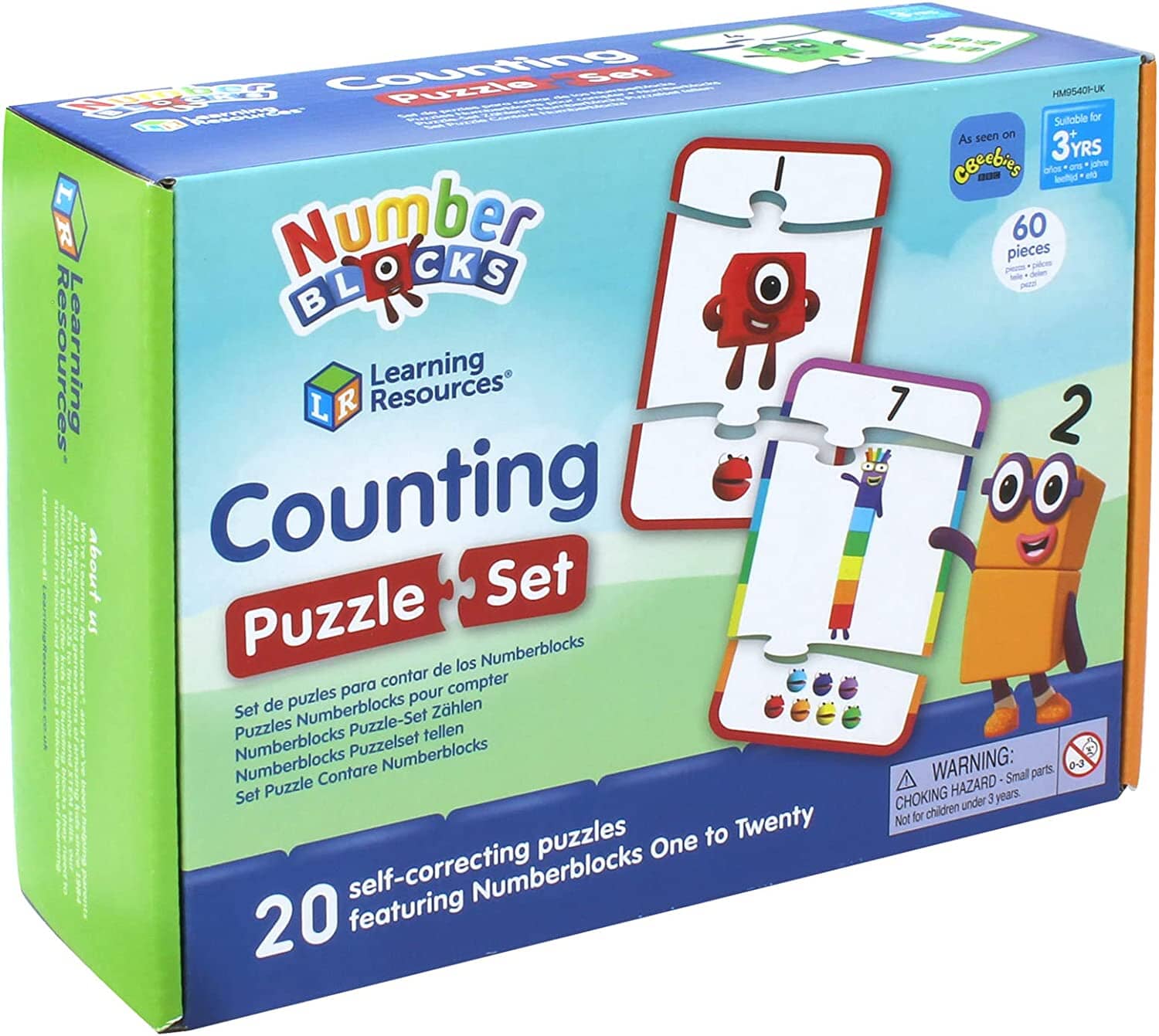
Numberblocks Counting Puzzle Set by Learning Resources - Ages 3 Years+ Learning ResourcesNUMBERBLOCKS AS SEEN ON TV: Learn to count from 1–20 with the friendly Numberblocks! These Numberblocks jigsaw puzzles are based on the friendly characters children know and love from the award-winning TV series. COUNT FROM 1–20: Make learning to count fun! As children complete the 20 counting puzzles, they’ll be counting the Numberblocks and Numberblobs, identifying each Numberblock’s Numberling, as well as building colour recognition and fine motor skills. MATCH NUMBERS & PICTURES: Match the Numberblock to its Numberling, and then see if you can match the puzzle piece with the correct number of Numberblobs to complete the puzzle. SELF-CORRECTING PUZZLES: Each of these clever self-correcting Numberblocks counting puzzles fits together in a unique way, so there’s only one right answer. INCLUDES: 20 x 3-piece puzzles. The chunky pieces are made from durable card and are easy for little hands to hold. Pieces store in the reusable packaging after play. Completed puzzles measure 15cm L x 10cm W.14,99 £*Shipping: 2,99 £Secure redirect to the provider
-
Numberblocks Sequencing Puzzle by Learning Resources - Ages 3 Years+ - Educational Toy Learning ResourcesNUMBERBLOCKS AS SEEN ON TV: Help children learn to sequence the numbers 1–20 in the correct order with their friends Numberblocks One to Twenty from the hit TV series. LEARN TO COUNT 1–20: Make learning to count 1–20 in the correct order fun for young children! As children complete the 20 colourful puzzles, they’ll be building basic maths skills along with colour recognition and fine motor skills. MATCH NUMBERS & PICTURES: Start with the 1-5 Numberblocks sequencing puzzles – can you put your friends One, Two, Three, Four, and Five in the correct order? As children learn and grow, progress to the next puzzle. PERFECT FOR LEARNING: Each of these Numberblocks maths puzzles is colour-coded for easy set-up. Each puzzle also has a number line, a teaching tool to help children sequence numbers and use to solve simple maths problems. INCLUDES: 10 double-sided puzzles - 4 each of puzzles for 1–5 (13cm L x 15cm W) and 1–10 (26cm L x 15cm W) and 2 for numbers 1–20 (51cm L x 15cm W).11,99 £*Shipping: 2,99 £Secure redirect to the provider
-
Numberblocks Puzzle Solver by Learning Resources - Ages 3 Years+ - Educational Toy Learning ResourcesPuzzle pals, it’s time to play and learn with the Numberblocks® Puzzle Solver where players place the Numberblocks pieces to solve the maths puzzles. As children twist, flip and place the pieces onto the 50 puzzle challenges, they’ll be building their maths, problem-solving, critical thinking and spatial reasoning skills through hands-on play. This solitaire game is easy to set up and play, simply choose a challenge card and insert it under the clear tray. Then find the Numberblocks puzzle pieces that match the card and use them to complete the puzzle. With 4 challenge levels, this portable puzzle game will keep your child engaged and learning as they grow. What’s more, all the pieces store inside the play case, making it an ideal travel game. Build maths skills through fun puzzle play with Numberblocks Puzzle Solver. How to play: Choose a challenge card and insert it under the clear tray. Find the Numberblocks puzzle pieces that match the card. Use the pieces to complete the puzzle. There are 50 challenges and 4 levels of play, to keep your child engaged and learning as they grow. Includes 25 double-sided challenge cards, 16 character pieces, 1 plastic play case and Activity Guide. Pieces store inside the play case after playtime is over.16,99 £*Shipping: 2,99 £Secure redirect to the provider
-
What will workshops for disabled people look like in 20 years?
In 20 years, workshops for disabled people will likely be more inclusive and accessible, with a focus on utilizing technology to cater to individual needs. These workshops may offer virtual reality training, online resources, and remote participation options to accommodate a wider range of disabilities. There will also be a greater emphasis on promoting independence, self-advocacy, and skill development tailored to each person's abilities and interests. Overall, workshops for disabled people in the future will strive to create a more inclusive and empowering environment for individuals with disabilities to thrive and reach their full potential. **
-
Why was education underfunded for years?
Education was underfunded for years due to a variety of reasons. One major reason is competing budget priorities, such as healthcare, infrastructure, and defense, which often took precedence over education funding. Additionally, economic downturns and budget constraints led to cuts in education spending. Furthermore, political disagreements and lack of consensus on the importance of education investment also contributed to underfunding. These factors combined to create a situation where education was not given the necessary financial support to meet the needs of students and schools. **
-
How can one proceed at 27 years old without any training or education?
At 27 years old without any training or education, one can start by assessing their interests, strengths, and skills to determine potential career paths. They can consider enrolling in online courses, vocational training programs, or community college classes to gain relevant skills and knowledge. Networking with professionals in industries of interest, seeking mentorship, and gaining hands-on experience through internships or volunteering can also be beneficial in building a career without formal education. It's important to stay motivated, be open to learning, and be willing to put in the effort to succeed in a chosen field. **
-
Starting an education at 25 years old?
Starting an education at 25 years old is a great decision for many people. It allows individuals to pursue their academic and career goals, gain new skills, and expand their knowledge. Many people choose to start or continue their education at this age due to personal or professional reasons, and it can lead to new opportunities and personal growth. It's never too late to invest in education and work towards achieving your goals. **
Similar search terms for Years
-
Numberblocks Adding and Subtracting Puzzle Set by Learning Resources - Ages 3 Years+ Learning ResourcesNUMBERBLOCKS AS SEEN ON TV: Discover what happens when you add or subtract 1 with these simple 2-piece Numberblocks jigsaw puzzles based on the award-winning TV series. ADD & SUBTRACT: Make learning simple addition and subtraction fun for young children! As children complete the 20 colourful puzzles, they’ll be building basic maths skills along with colour recognition and fine motor skills. MATCH NUMBERS & PICTURES: See the addition or subtraction question, count the Numberblocks on the puzzle piece, and then find the correct answer piece. SELF-CORRECTING PUZZLES: Each of these clever self-correcting Numberblocks counting puzzles fits together in a unique way, so there’s only one right answer. INCLUDES: 20 x 2-piece puzzles. The chunky pieces are made from durable card and are easy for little hands to hold. Pieces store in the reusable packaging after play. Completed puzzles measure 15cm L x 10cm W.14,99 £*Shipping: 2,99 £Secure redirect to the provider
-
Numberblocks Memory Match Game by Learning Resources - Ages 3 Years+ - Educational Toy Learning ResourcesNUMBERBLOCKS AS SEEN ON TV: Test memory skills, build number sense, and practise early maths concepts with this fun Numberblocks matching pairs game. Children will love finding and pairing their favourite Numberblocks and friends. MEMORY GAME FOR AGES 3+: Matching pairs is a classic memory game for children. This fun picture snap pairs game for kids age 3 years and up promotes number recognition and matching skills as children play and learn. 40 MATCHING PAIRS: Flip over the cards, and then match and pair by Numberblocks One to Ten, Numberlings, Number Fun, and Numberblobs. Use fewer cards for younger children and add more cards to make the game more challenging for older children. HIGH QUALITY: The 80 full-colour cards are made from durable card and feature colour-coded borders for easy game set-up. Cards measure 5cm x 5cm and are perfectly sized for little hands to hold as children play. Suitable for 1 or more players. INCLUDES: 80 full colour cards and How to Play guide. Cards and guide are easy to pack away and store in the durable, reusable packaging. This feature makes our Numberblocks Memory Match Game an ideal travel game.11,99 £*Shipping: 2,99 £Secure redirect to the provider
-
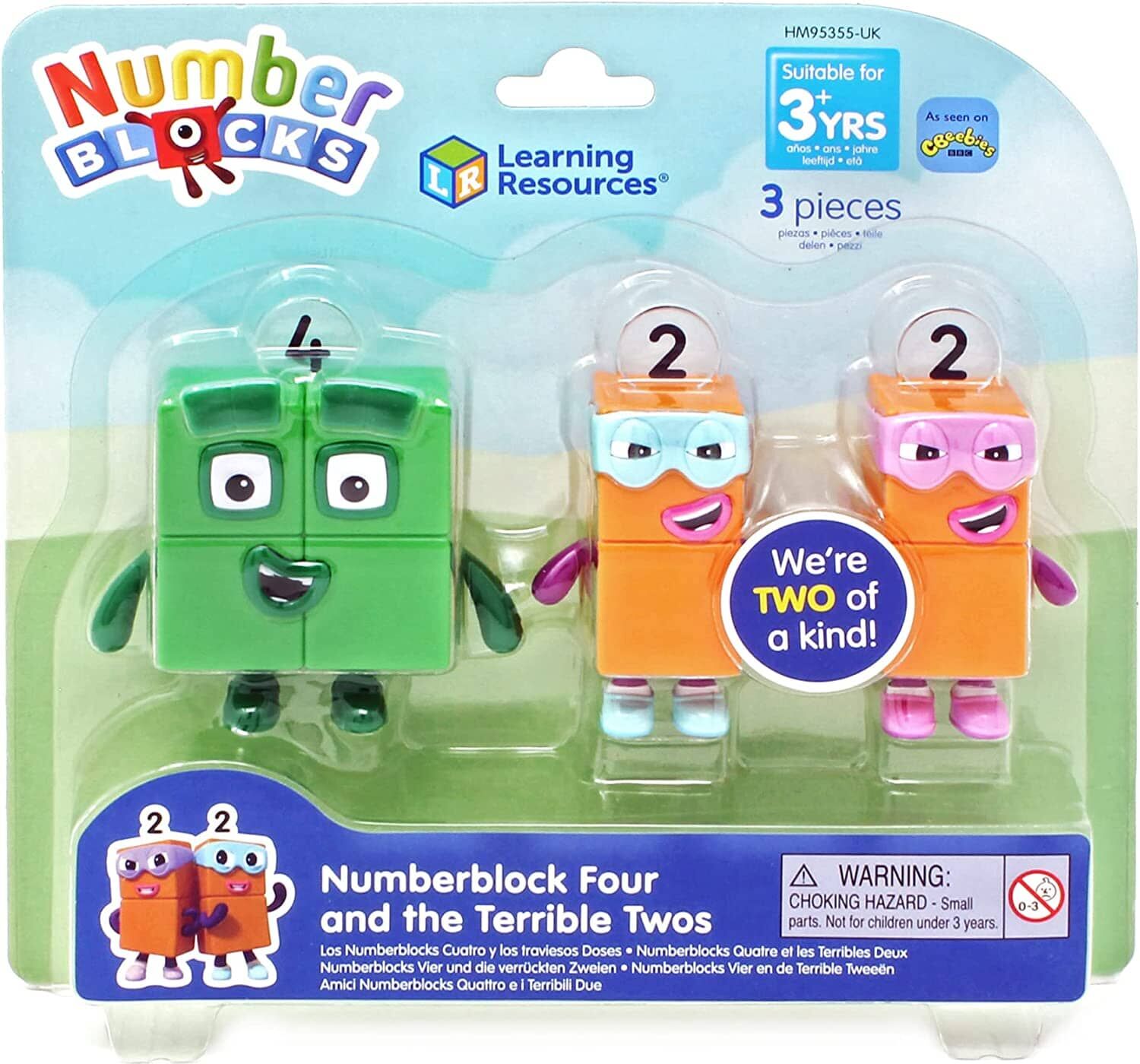
Numberblock Four and The Terrible Twos by Learning Resources - Ages 3 Years+ Learning ResourcesNUMBERBLOCKS AS SEEN ON TV: The world of Numberblocks comes to life as children create their own Numberblocks adventures at home with Numberblocks Four and the mischievous Terrible Twos collectible figures, based on the award-winning TV series. INCLUDES FOUR AND 2x TERRIBLE TWO: Two plus Two makes Four! Double up on the mischievous play adventures with the 2 x Terrible Twos figures, perfect for helping children build essential early years maths skills as they play. POSABLE ARMS: Move their arms while playing or stand your Numberblocks friends up on display. There’s so much more to explore with these fun-loving figures that are perfectly sized for little hands. MORE TO EXPLORE: There are even more official Numberblocks collectible figures from Learning Resources ready for children to create their own adventures in Numberland (sold separately). Collect them all! INCLUDES: Numberblock Four and 2 of the Terrible Twos. (3 Pieces) Figure measure 8.5cm H.10,99 £*Shipping: 2,99 £Secure redirect to the provider
-
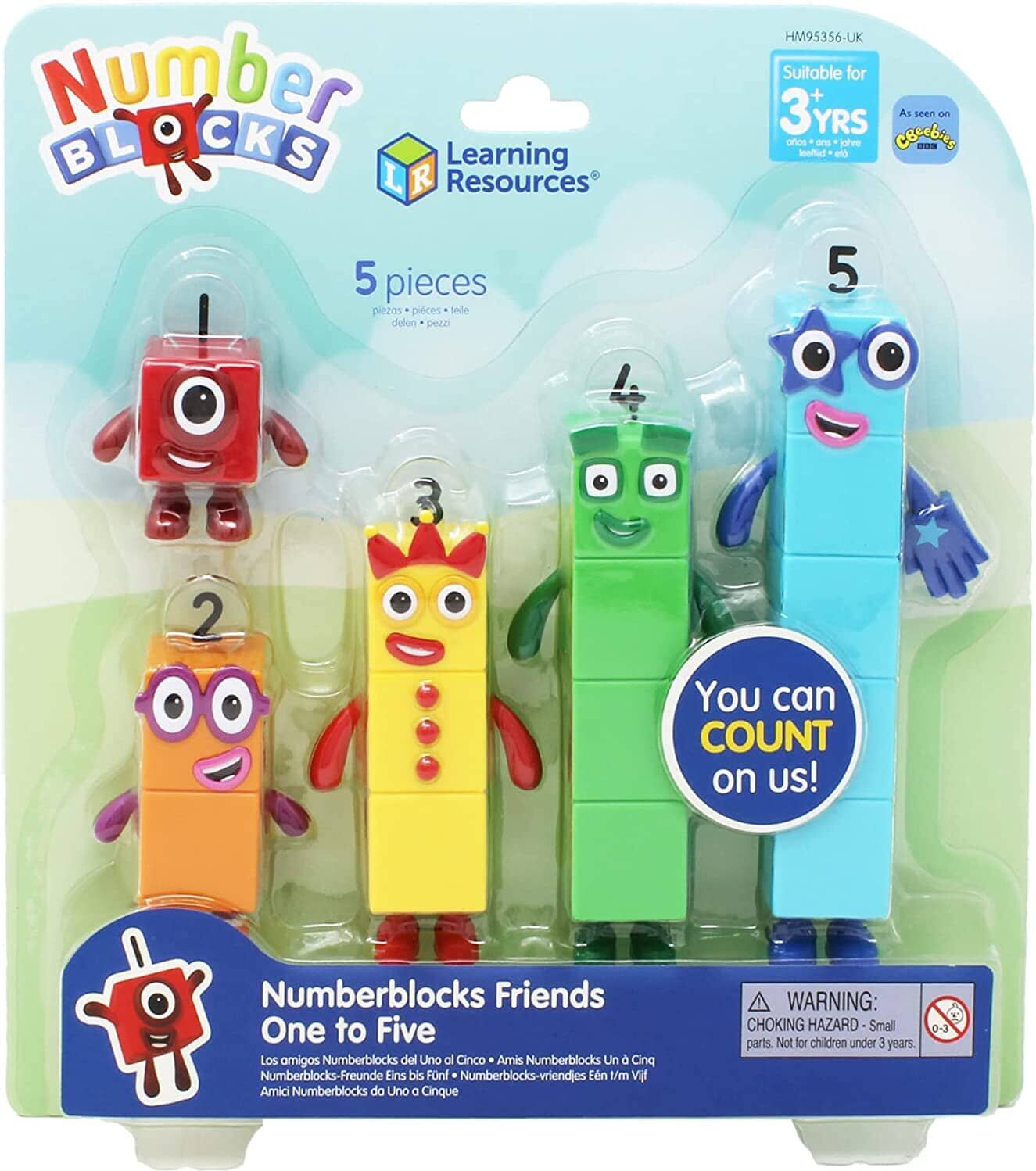
Numberblocks Friends One to Five by Learning Resources - Ages 3 Years+ - Educational Toy Learning ResourcesNUMBERBLOCKS AS SEEN ON TV: The world of Numberblocks comes to life as children create their own Numberblocks adventures at home with their Numberblocks Friends One to Five collectible figures. INCLUDES NUMBERBLOCKS ONE TO FIVE: These five adorable friends are packed with personality and have the true-to-character features children know and love from the series. Five even has her large counting hand! POSABLE ARMS: Move their arms while playing or stand your Numberblocks friends up on display. There’s so much more to explore with these fun-loving figures that are perfectly sized for little hands. MORE TO EXPLORE: There are even more official Numberblocks collectible figures from Learning Resources ready for children to create their own adventures in Numberland (sold separately). Collect them all! INCLUDES: Numberblock One (5.5cm H), Two (8.5cm H), Three (11cm H), Four (13.5cm H), and Five (16.5cm H). (5 Pieces).16,99 £*Shipping: 2,99 £Secure redirect to the provider
-
Do repeated years count towards compulsory education?
In most cases, repeated years do count towards compulsory education. Compulsory education laws typically require students to attend school for a certain number of years or until they reach a certain age, regardless of whether they repeat a grade. However, the specific rules may vary by state or country, so it's important to check the local laws and regulations to confirm whether repeated years count towards compulsory education. **
-
Why does training last three years?
Training typically lasts three years in order to provide individuals with a comprehensive education and hands-on experience in their chosen field. This duration allows for a deep understanding of the subject matter, ample time for skill development, and the opportunity to gain practical knowledge through internships or on-the-job training. Additionally, a three-year training period ensures that individuals are well-prepared and competent in their profession before entering the workforce. **
-
"Excuse for physical education at 18 years old?"
At 18 years old, there may be various reasons someone could provide as an excuse for not participating in physical education. Some possible reasons could include a medical condition or injury that prevents them from engaging in physical activities, a scheduling conflict with other academic or work commitments, or personal reasons such as feeling uncomfortable in a group exercise setting. It is important for individuals to communicate their reasons to their school or instructor in order to find a suitable alternative or solution. **
-
Excuse for physical education at 18 years old?
At 18 years old, a valid excuse for not participating in physical education could be a medical condition or injury that prevents the individual from engaging in physical activity. In such cases, a doctor's note or medical documentation may be required to support the excuse. Additionally, personal reasons such as mental health issues or religious beliefs could also be considered valid excuses for not participating in physical education at 18 years old. It is important to communicate any valid reasons for not participating in physical education to the appropriate school authorities. **
* All prices are inclusive of VAT and, if applicable, plus shipping costs. The offer information is based on the details provided by the respective shop and is updated through automated processes. Real-time updates do not occur, so deviations can occur in individual cases. ** Note: Parts of this content were created by AI.